
Town of Islip Street Workflow
Use one street address as the starting point, not a name. The first task is to turn the physical location into a stable parcel or tax-map identity. The Town assessment-roll route and Suffolk County GIS provide the current parcel context. The Suffolk County Clerk Records Kiosk then joins the address to land documents. A deed can identify parties to a transfer, while a registration record may only be checked through its separate lawful route. Neither source proves that every person at an address is part of one household.
- Enter the full situs address through the Town of Islip Assessor or the assessment-roll handoff and record the tax-map or parcel identifier when available.
- Open the Suffolk County GIS Viewer, locate the street segment, and use its parcel and address-label layers to confirm the mapped parcel.
- Use the Suffolk County Clerk Records Kiosk address finder to obtain the tax-map components and move into the deed index.
- For a named registered voter, use the individual NYS Voter Lookup or the Board of Elections access route. It is not a by-street roster.
- For an earlier period, compare the street and number with an identified historical directory, newspaper, atlas, or library source. Preserve the publication date beside the address.
That sequence keeps records in their proper roles. The parcel anchors the location, the deed chain documents a transfer, and a dated historical item can provide a household clue. When a name is common, match the address, tax map, document role, and recording date before treating two results as the same person.
Town of Islip Parcel Evidence
The Town of Islip Assessor maintains the assessment function and links to published assessment-roll material. It updates ownership after deed transfers and tracks physical changes such as construction, demolition, apportionment, and consolidation. The public municipal pages confirm an individual property and assessment-roll route, but they do not expose the live form’s exact labels or establish a public owner-name search. Treat any unconfirmed live control as a gap, not as a street-browse promise.
The Town Assessor source shows the assessment-roll entry point used for parcel research.
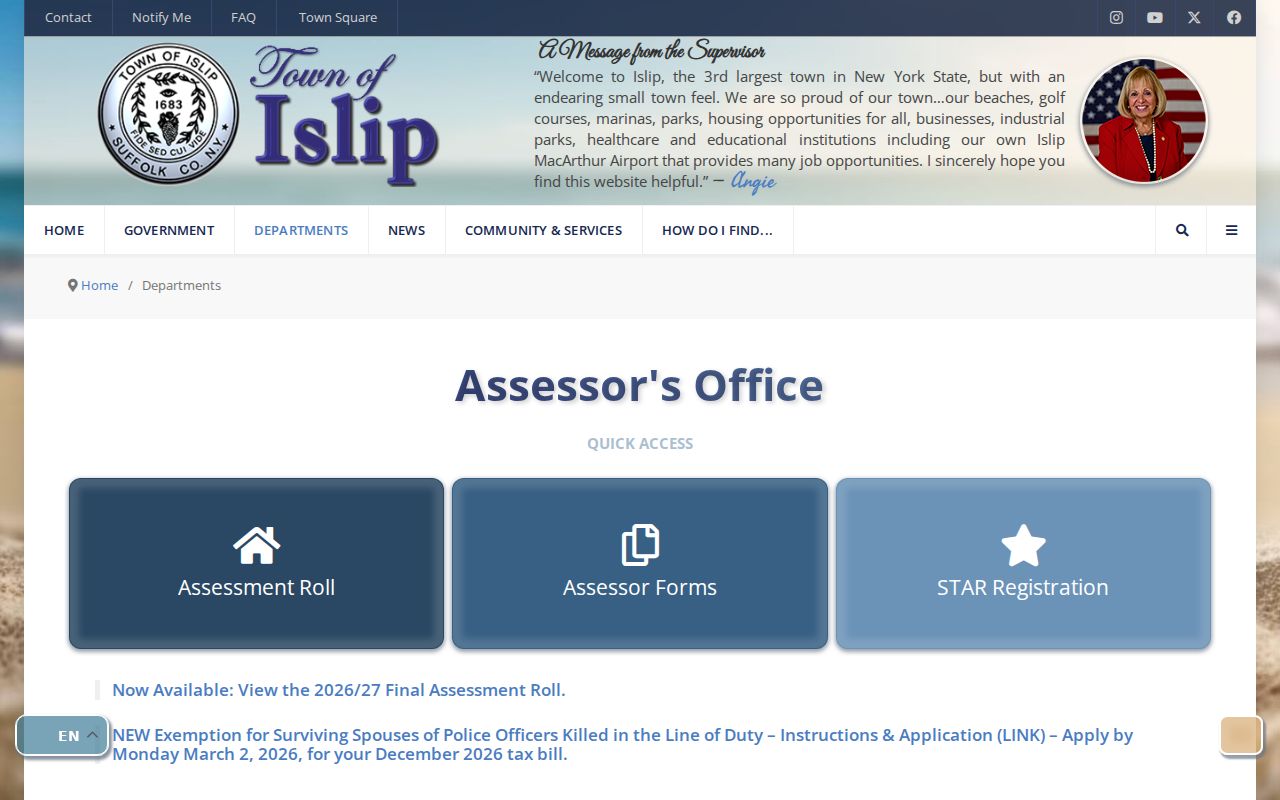
Assessment material can connect an owner of record, a situs address, a mailing address, value information, exemptions, and parcel characteristics, subject to the fields shown on the live result. The image does not establish a complete resident list.
A situs address is the physical parcel location. A mailing address is where the tax bill or owner correspondence goes, and it can be elsewhere. An owner name or exemption is therefore an ownership clue, not proof of current occupancy. The Receiver of Taxes also lets an owner print a tax bill through the Town tax links; a nonowner may seek a paper copy for $5 per parcel with the tax-map or item number, property address, requester name and direct phone, plus a self-addressed stamped envelope.
Town of Islip GIS Street Layers
The County GIS is the practical way to view a street as a line of parcels without claiming that the map is a resident directory. Its service includes Tax Parcels, a Tax Parcel Owners table, street and address labels, ZIP polygons, town and hamlet boundaries, school and sewer districts, building footprints, transportation layers, and environmental context. Use Identify on a parcel or Find within the viewer, then carry the parcel identity to the Assessor or Clerk.
The Suffolk County GIS MapServer documents the parcel, owner-table, district, and reference layers available for a Town of Islip street search.
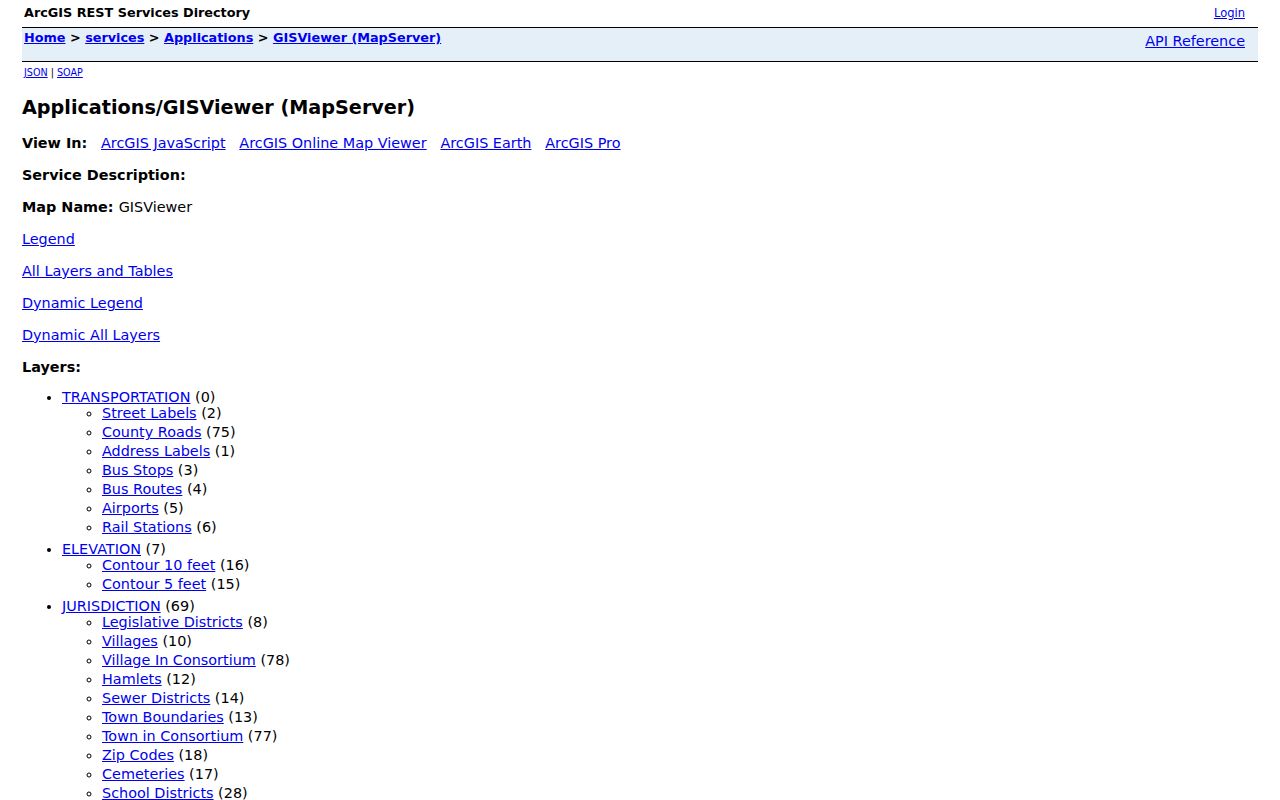
Pan along a street, identify one parcel at a time, and note the parcel identifier before opening another record system. The service supports Identify, Find, and query output, but selection results are capped at 2,000 and the County warns that map information is believed accurate rather than guaranteed.
| GIS control or layer | Use on a street | Limit to keep in mind |
|---|---|---|
| Identify | Click a parcel or visible feature for attributes | Visible layers affect the returned context |
| Find | Locate a mapped feature or street area | Exact viewer text fields were not captured |
| Tax Parcels | Compare parcel geometry along the street | Geometry does not prove occupancy |
| Tax Parcel Owners | Follow owner-associated information to another record | Visible join fields vary by viewer |
| ZIP and district layers | Check address geography and jurisdiction context | They are not delivery or residence confirmation |
Town of Islip Address Labels
Town, hamlet, post-office label, ZIP, parcel, and legal description can all describe the same location differently. The Town of Islip includes mainland hamlets and Fire Island communities, while postal labels do not always match municipal geography. The County Clerk finder can return city, state, ZIP, district, section, block, and lot along with address values. Keep those fields together when a street crosses a boundary or an older record uses a different label.
A parcel identifier is usually a safer bridge than a house number. Assessment, tax, and GIS tools depend on the parcel and situs. Deed books rely on legal description and Liber/page. Voter records use residence and election district, while historical directories use the printed street and house number. No official Town-wide street-renumbering or street-renaming chronology was located, so a change in a number or label should be researched rather than assumed.
- Parcel
- A mapped unit of land identified by a tax-map or parcel number.
- Situs address
- The physical address of the parcel or building, distinct from the owner’s mailing address.
- Plat
- A filed map that depicts lots or a subdivision and can connect a deed description to the ground.
- Criss-cross directory
- A reverse directory arranged by street and house number, when a dated local run is available.
Use the USPS ZIP Lookup for a current delivery format. USPS itself cautions that a ZIP result does not confirm that a person or organization is at the address.
Town of Islip Clerk Fields
The County Clerk’s address and tax-map finder is the handoff between a street address and the land index. Enter the situs house number and street name, then add ZIP when it will narrow the search. The result can expose group, name, address, city, state, ZIP, district, section, block, and lot values. The first 2,000 records are displayed, so a more exact address or constraint matters when a broad term returns too much.
| Clerk field | Type | Required | Street-search purpose |
|---|---|---|---|
| House Number | Text | No | Starts the address and tax-map finder |
| Street Name | Text | No | Use the situs street label |
| Zip Code | Text | No | Can narrow the address finder |
| Search for Tax Map ID | Button | Not applicable | Returns tax-map components and owner/address fields |
| Property Tax Map ID | Text | No | Searches a known parcel identifier |
| Liber and Page | Text pair | No | Opens a known deed or mortgage reference |
For name records, the portal has Last Name or Corporation, optional first name and suffix, date limits, and Starts With, Contains, or Exact preferences. Those controls are useful only after the parcel or document supplies a party name. A Liber/Page deed entry uses the Clerk’s deed format, while a mortgage uses its own format.
Town of Islip Deed Trail
The Suffolk County Clerk Records Kiosk has a free index route for recorded land material. Online land records are strongest from 1987 forward. A deed result shows Liber, Page, document type, grantee, grantor, date received, notations, and controls for certified copies or the document. Search the current owner as grantee, then use the preceding seller or grantor as a grantee to find an earlier purchase. The legal description and prior-deed reference help when a street label changes.
The County Clerk land-record search is the source for the address, name, and Liber/Page routes used in a Town of Islip street directory trail.
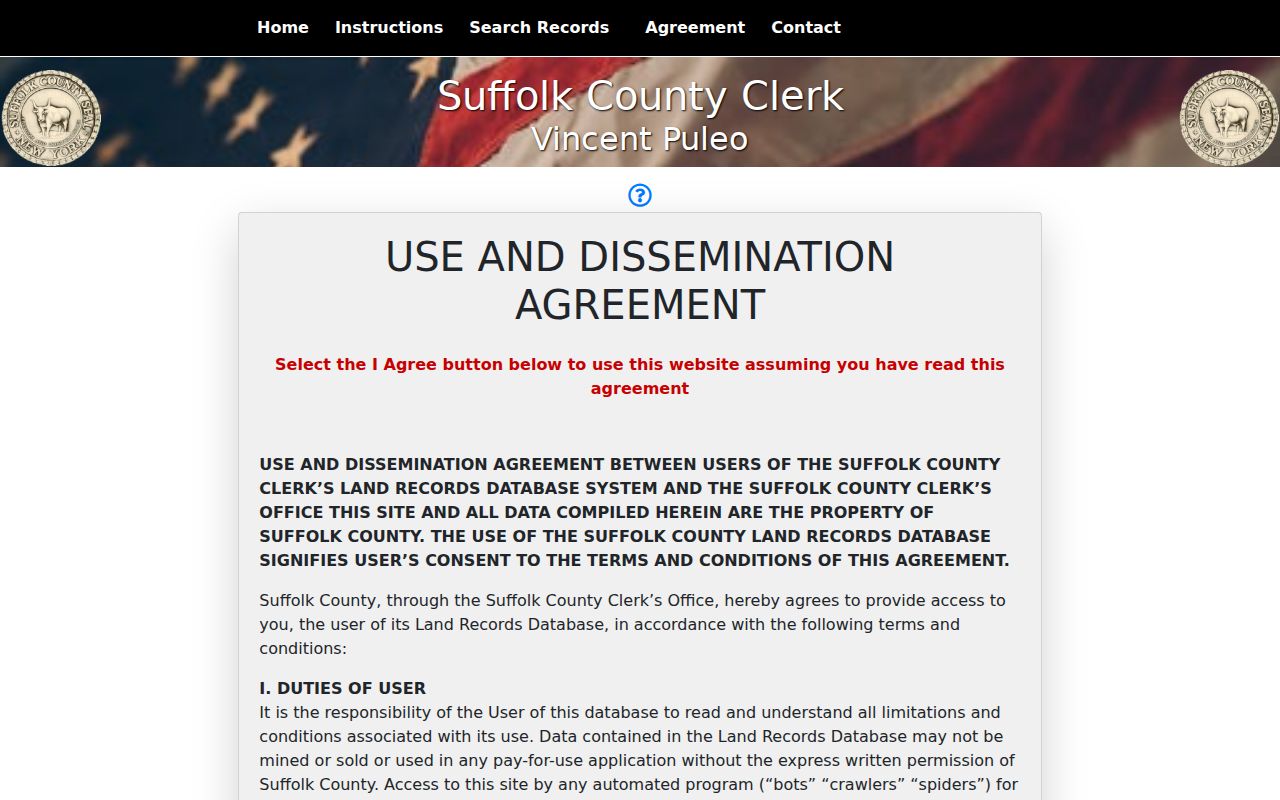
The image reflects an index interface, not an open image collection. A free index result and access to a document image are different paths. Paid subscribers can view document images after accepting the Use and Dissemination Agreement, and a certified copy can be requested without that subscription route.
For older documents, use the County Clerk public workstations, Riverhead microfilm, bound books, or staff direction at the Historic Documents Library. Mail or certified-copy requests go to the County Clerk at 310 Center Drive, Riverhead, NY 11901 and should identify the document, parties, book/page or index number, property, and requested copy type. The Clerk’s current guidance says to verify the document-specific charge at the counter.
Town of Islip Building Records
Address-keyed Town material can add a construction or change timeline after the parcel and deed trail are stable. Surveys, permits, certificates of occupancy, plans, and inspection reports are directed through the Building Department tab on the Town’s FOIL page. FOIL means the New York Freedom of Information Law, Public Officers Law Article 6. A useful request names the full situs address, tax-map number, approximate date range, record type, and whether inspection or copies are sought.
Code-enforcement material uses a different route. The Town’s violation-search form is an address or tax-map request that charges $100. The Planning portal requires an account for filing and tracking, and no public permit-by-address result screen was located. These record types can date a change or identify an applicant when released, but they do not turn a street address into a complete list of residents.
Note: Ask the Town office about any release restriction instead of inferring that an unavailable web result means no record exists.
Town of Islip Voter Limits
The individual NYS Voter Lookup requires a last name, first name, date of birth, county, and address information in its workflow. It can help a registered voter check registration or polling and ballot information for a supplied identity. It cannot be used to browse an entire Town of Islip street. A non-match is not proof that a person never lived there, because an address may have changed, a record may be inactive, or information may be protected.
The NYS Voter Lookup source shows the individual registration and poll-site service used for a lawful Town of Islip street directory check.
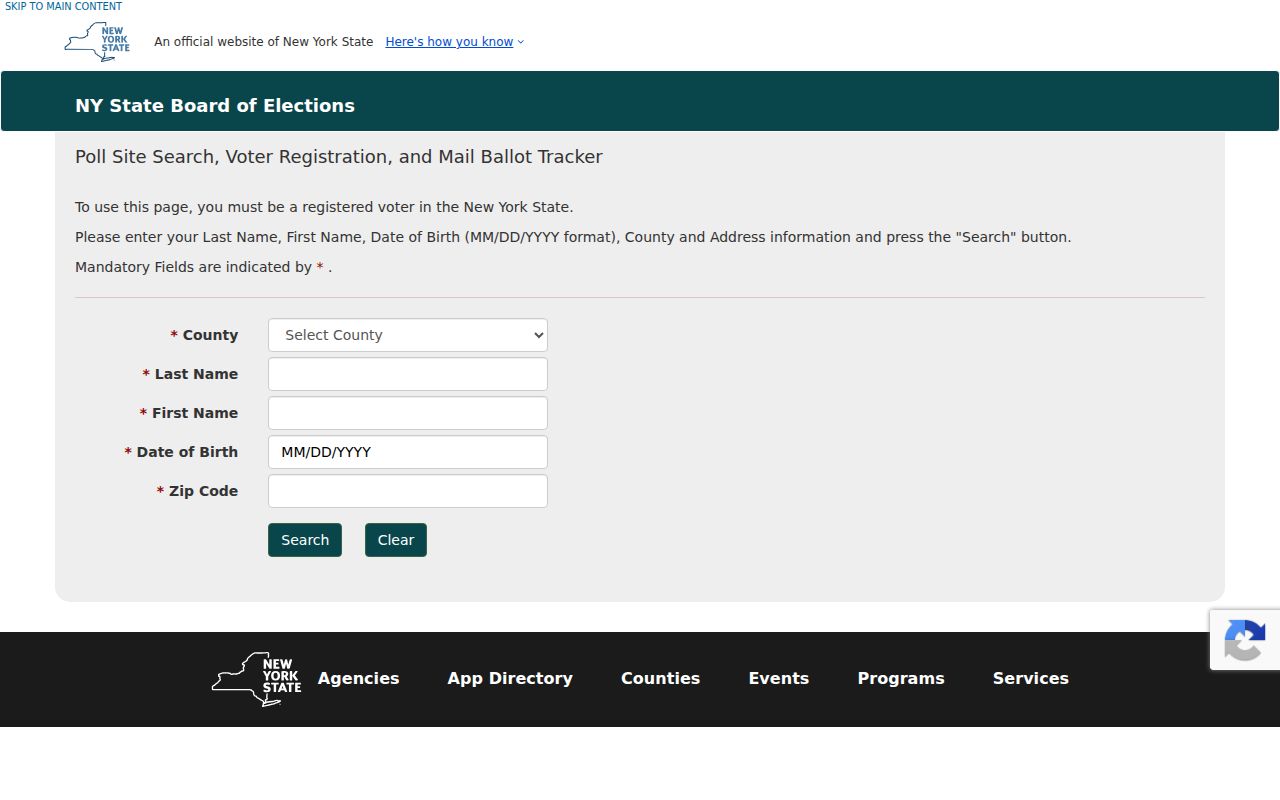
New York Election Law §3-220 permits supervised inspection of registration records but withholds driver-license, DMV, Social Security, and signature-type identifying information. Section 5-602 describes an election-district list during a statutory publication window that may be arranged by street and number. It is not an unrestricted online household list, and ballot choices are secret.
Other channels remain available when the individual service does not answer the question: the Suffolk Board of Elections directs local forms and services through Yaphank; the NYS Board of Elections FOIL route uses GovQA for written requests; and historical newspapers or local-history files may offer dated context. A voter-data request must state an elections purpose under Election Law §3-103(5). The exact bulk file format and county-specific request form were not located.
Town of Islip Historical Streets
Older street evidence needs a date beside it. The Islip Public Library genealogy collection offers local-history resources, historical newspapers, yearbooks, and databases available with a library card or in the library. Its Local History Room holds Islip High School yearbooks from 1940 forward. These resources can help place a person, school, family, or community connection in time, but a yearbook is not an address record.
Exact Town of Islip printed reverse or criss-cross directory runs were not located in the official research. That gap matters. Verify the title, publisher, year, arrangement, and abbreviation key before using a directory as a street source. Historical address collections are handled in more detail with the Town of Islip city directories, while a current parcel chain belongs in the land records above.
For a building before the regular permit era, use a legal description with an historic atlas or Sanborn map rather than assuming the present house number always applied. The County Clerk’s historic atlases begin around 1873, and the Library of Congress has a December 1890 Islip set of five Sanborn sheets. Those maps can anchor a lot or building footprint, not name every occupant.
Town of Islip Street Record Coverage
Each address-keyed source answers a different question. Use a tax-map number and a document date to prevent the street directory from blending owner, mail, and historical clues into one unsupported claim.
| Address record | Custodian | What it can show | Access channel |
|---|---|---|---|
| Assessment roll or parcel card | Town of Islip Assessor | Owner of record, situs, mailing address, exemptions, and physical data | Assessor and assessment-roll route; exact interactive fields remain unconfirmed |
| Tax bill | Receiver of Taxes | Tax-map or item number and billing information | Owner print route or $5 nonowner paper request |
| GIS parcel | Suffolk County GIS | Parcel geometry, adjoining parcels, owner table, and district context | Public viewer or REST query, subject to limits |
| Deed index | Suffolk County Clerk | Grantor, grantee, Liber/Page, type, and recording date | Free online index, paid image or copy route, counter and historic records |
| Building records | Town Building Department | Permit, plan, inspection, certificate, or survey trail | FOIL Building tab and office decision |
| Registration record | NYS and Suffolk elections offices | Individual registration information under statutory controls | Individual lookup, supervised route, or qualified written request |
Town of Islip Clerk Tip
Free index access is not the same thing as free document-image access. The County Clerk kiosk can provide index details without a subscription, while image viewing has a paid enhanced-service route and copies use separate procedures. When an address search finds the current deed, record its Liber, Page, legal description, and prior-deed reference before leaving the result. That small set of fields is the fastest bridge from a present street label to the earlier title trail.
Insider tip. A current deed’s Liber/Page and prior reference often save time at Riverhead because they point to the older volume before a broad name search begins.
For a record before the online period, bring those notes to the Historic Documents Library or public access area. The historical route uses a countywide alphabetical index for 1660 through 1950, town-divided books for 1951 through 1969, and public-access terminals after 1969.
Town of Islip Street Directory Limits
A parcel owner, a mailed tax address, an owner-table entry, and an individual voter response are not interchangeable. Utility and delivery-customer records are not public, DMV address data is closed under the Driver’s Privacy Protection Act, and protected voter information remains confidential. The New York Address Confidentiality Program can also protect a participant’s address. A street result should never be treated as a full household roster.
Lawful use. Town of Islip street records support personal, civic, family-history, and property research. Do not use them to stalk, harass, intimidate, or harm anyone.
When evidence conflicts, return to the custodian that created it. Ask the Assessor about a parcel, the County Clerk about a recorded document, the elections office about registration access, and the Town FOIL office about municipal records. That approach preserves the limits each source actually has.