
Town of Islip Previous Resident Eras
One address has several possible evidence trails, and their date ranges are not interchangeable. Start with the newest transfer to establish the current legal identity. Then select the source that covers the earlier period. The County Clerk is the main deed custodian, while maps, directories, census schedules, and family records help distinguish an owner from people who may have lived there at a particular time.
| Source | Era covered | Where held | What it contributes |
|---|---|---|---|
| County Clerk online land index and images | 1987 to present for online land records | Records Kiosk and image or copy route | Deed and mortgage parties, Liber/Page, recording date, and document access controls |
| County Clerk historic land records | 1660 to present, with changing index methods | Riverhead counter, public workstations, microfilm, bound books, and Records Room | Grantor, grantee, legal description, and older volume references |
| Town assessment roll | Current roll; older exact online run not located | Town of Islip Assessor and assessment-roll route | Parcel, owner-of-record, situs, mailing address, value, and exemption context |
| Historic atlases and Sanborn maps | Atlases begin about 1873; Islip Sanborn set is December 1890 | Historic Documents Library, Library of Congress, and SUNY Stony Brook microfilm | Lot, building, owner, or footprint context, with no complete occupant list |
| Directories and census schedules | Exact local directory run not located; federal census through 1950 | Library, historical sources, and census repositories | Dated household or community clues that need identity checks |
| Building records, obituaries, and probate | Record-specific; permits generally not expected before the early 1920s | Town FOIL route, newspapers, and Surrogate’s Court | Construction, death, heir, and transfer context |
For a recent transfer, the deed index is usually the first stop. For an older address, the Riverhead land-record route may be necessary before a printed or historical source can be interpreted safely. A directory date indicates a point in time, not a continuous period of residence.
Town of Islip Deed Starting Point
Begin with the current situs address in the Town assessment material or County GIS, then keep both the tax-map identifier and the current owner clue. Use the Suffolk County Clerk Records Kiosk address finder with house number, street name, and ZIP to obtain the tax-map components. The newest deed is the pivot for an earlier-occupant search because it identifies the parties, document date, Liber/Page, legal description, and any cited earlier deed.
- Confirm the present parcel through the Town of Islip Assessor or Suffolk County GIS and save the situs and tax-map identity.
- Find the current owner’s purchase deed in the Clerk’s name or address and tax-map search.
- Record the Liber, Page, recording date, legal description, grantor, grantee, and prior-deed citation from the result.
- Use the prior Liber/Page directly when the deed gives one. If it does not, search the seller or grantor as the next older grantee.
- Repeat the sequence until the online period ends or the lowest usable Liber directs the search into the older books.
A person may appear under a trust, estate, corporation, spouse, or former name. Use the portal’s Starts With, Contains, and Exact options, along with a date range and document role, when a party search is broad. A later deed involving the same surname is not enough by itself. The parcel or legal description must support the match.
Town of Islip Liber Page Trail
Liber and Page are the Clerk’s volume-and-page references for a recorded document. They are more useful than a bare street number when a past residents search reaches older material. Save both values, plus the prior reference, before changing search modes. The County Clerk result interface also supplies document type, grantor, grantee, date received, notations, and certified-copy or document controls.
The County Clerk land-record search provides the Liber/Page, address finder, and party-search modes used to trace Town of Islip previous residents.
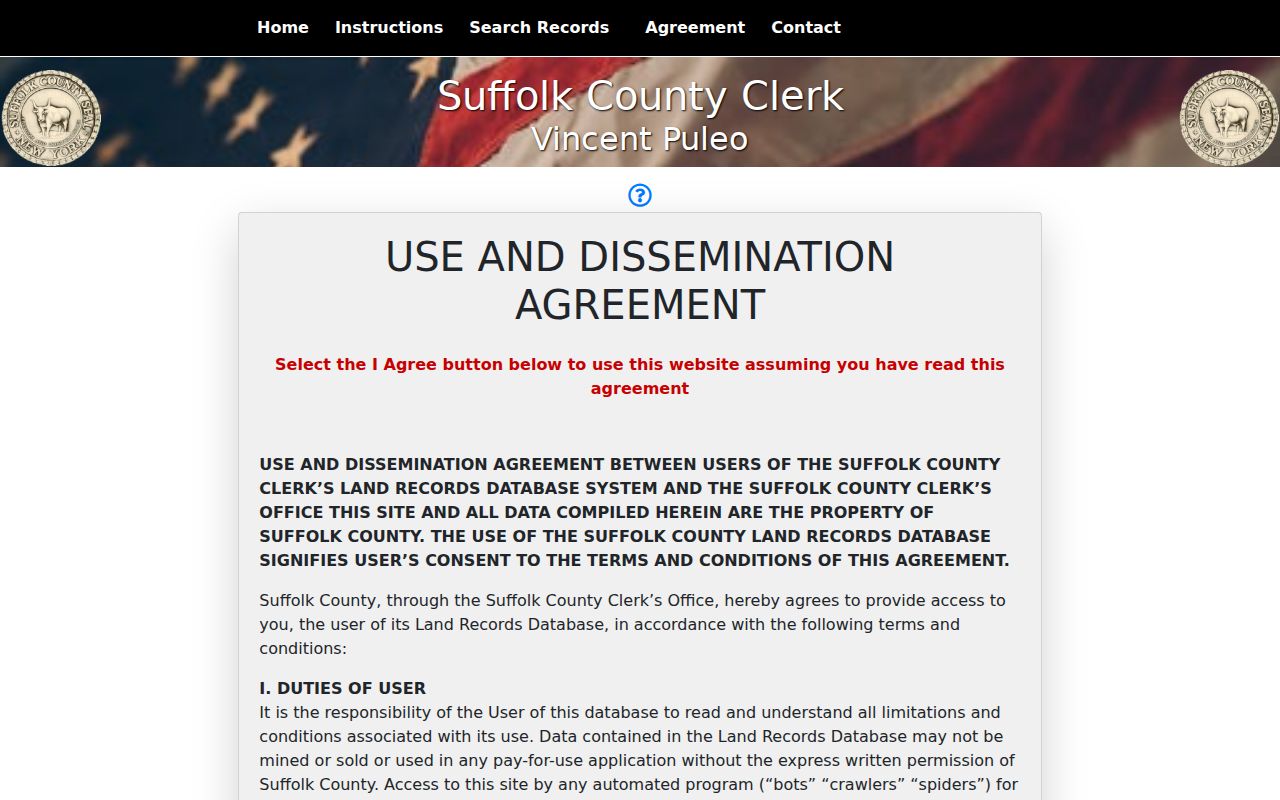
The image is an index interface. Its result fields direct a searcher toward the recorded document, but an indexed party is not automatically proof of a resident household. Use the legal description and recording sequence to keep the address trail intact.
- Grantor
- The party transferring an interest in the property, often the seller in a deed.
- Grantee
- The party receiving that interest, often the buyer in a deed.
- Chain of title
- The sequence of recorded transfers that connects one owner or interest holder to an earlier one.
- Legal description
- The lot, map, metes-and-bounds, or other formal property identity that can survive a changed street number.
Town of Islip Image Access Myth
The free County Clerk kiosk search does not mean every document image is free to view online. It provides index information without a subscription. The enhanced image service requires acceptance of a Use and Dissemination Agreement, and paid subscribers can view document images. A certified copy can be requested without the subscription route. Confirm the charge for the exact document type and copy type with the Clerk.
Myth. An online index hit is a lead to the document, not a complete digital file or proof that the image will be available without a paid or copy-request path.
The County Clerk’s published guidance says a plain deed copy does not exceed $5 and a mortgage copy is $40; certified court-copy guidance gives a $5 minimum plus $1.25 per page after four, capped at $40. Those are category-specific instructions, so verify the applicable fee before requesting a record.
Town of Islip Records Before 1987
Online land records are strongest from 1987 forward. The earlier trail belongs at the Suffolk County Clerk’s Riverhead access points. Land transactions can be researched from 1660 forward through public workstations, microfilm, bound books, and the records room. The methods change by era: one county alphabetical index covers 1660 through 1950, town-divided indexes cover 1951 through 1969, and public-access terminals are the efficient bridge after 1969.
When no Liber is known, look in the appropriate seller or grantor index. Pre-1969 books index both buyer or grantee and seller or grantor names. Older documents may require staff guidance, microfilm, a bound volume, or a transcription, and some records may be on Mylar. The County Clerk’s Public Access information is the starting route for those materials.
Mail and certified-copy requests use the County Clerk at 310 Center Drive, Riverhead, NY 11901. Identify the document, parties, book/page or index number, property, and requested copy type, and use the current copy instructions for routing and payment. If an online search is silent, ask whether the material is in the office, microfilm, bound books, or the Records Management Center.
Town of Islip Historic Documents
The County Clerk’s Historic Documents Library publishes the local backward-search method: current deed, Liber/Page, prior reference, lowest Liber, then the backward index and books. Bring the current deed information and the parcel’s legal anchors. The library is the distinctive fallback when the records needed for a previous residents trail predate the online collection.
The Historic Documents Library guide shows the County Clerk’s backward deed and house-history process for a Town of Islip previous residents search.
The guide supports following a document reference into older indexes, rather than treating a web search as the full record trail. It also points to mortgage Libers, atlases, Sanborn maps, and building records as supporting address evidence.
The library is open Monday through Friday from 9 a.m. to 5 p.m. except county holidays. Documents are not pulled after 4:15 p.m., and researchers finish by 4:45 p.m. Plan the visit around those pull rules, especially when several volumes may be needed.
Town of Islip Maps and Permits
When a deed cannot yet name the earlier people connected to a location, maps can establish the building and lot context first. The County Clerk’s historic atlases begin around 1873 and may show owner names, buildings, and sometimes story counts. The Library of Congress Islip Sanborn source has a December 1890 set of five sheets. SUNY Stony Brook also holds local Sanborn microfilm. Neither map source supplies a complete occupant list.
Mortgage Libers can help date financing or major change. Building permits are generally not expected before the early 1920s. For later records, ask the Town Building Department through the Town FOIL page for permits, certificates of occupancy, plans, surveys, or inspections by address, tax map, and year. The release decision rests with the agency, so do not infer that a missing online result means no file exists.
Note: Use a mapped structure or lot as an address bridge, then seek a deed, dated directory, or other record before making a claim about a person.
Town of Islip Address Continuity
No official Town-wide chronology of street renumbering or renaming was located. That is a real research gap, not proof that present numbering always existed. A legal description, tax-map number, section, block, lot, filed map, historic atlas, Sanborn block or house number, and deed Liber/Page are the safer continuity tools. They can reveal that two different street labels refer to the same land, or that a familiar number cannot yet be carried into an older record.
The County Clerk address finder returns district, section, block, and lot as well as address values. Assessment and GIS tools key on parcel and situs; deed books key on legal description and Liber/Page; old directories key on printed address. Keep a dated note for each version instead of merging them into one modern-looking address.
Town of Islip Past Households
Ownership is only one part of tracing previous residents. Pair a transfer date with a directory, census schedule, obituary, or local newspaper for the same period. The Islip Public Library genealogy resources lead to local-history material, historical newspapers, yearbooks, and database access. Its Local History Room holds Islip High School yearbooks back to 1940, which can provide dated community context but not proof of an address.
- Choose a deed or assessment date that anchors the parcel in a particular period.
- Find a directory or newspaper issue from as close to that period as the collection allows.
- Compare the printed address with the legal description, map, or tax-map bridge when numbering is uncertain.
- Check the nearest released federal census schedule for a household snapshot and its enumeration date.
- Record conflicts as conflicts rather than treating a later address or a shared surname as a match.
Exact Town of Islip reverse-directory runs were not located in the research, so the title, year, and arrangement must be confirmed before relying on one. Historical collections and their limits are also useful context in the Town of Islip city directories section.
Town of Islip Trail Endpoints
An obituary or probate file can close a title question when a property passes after a death rather than through an ordinary sale. The County Clerk house-history guidance directs researchers to Surrogate’s Court for a will when an owner died. Heirs can explain a later grantee, but the court record, date, parcel, and identity still need to align. An obituary may add a spouse, children, or another town, yet it remains a dated historical clue that must be checked against the newspaper or archive.
There is no single official Town-wide index for all obituaries or probate files in the research. Use the library’s newspaper and local-history channels, then confirm a relevant estate or will through the county court route. The research did not locate a public Surrogate search portal, so counter and clerk procedures need confirmation for a specific request.
Town of Islip Previous Resident Limits
Previous residents research is strongest as house history, family history, estate research, and local history. A current owner, an owner mailing address, an old directory entry, and a census household each describe different facts at different dates. None automatically identifies every person who lived at a location. The Town assessment record itself separates situs and owner mailing address, and that difference must remain visible in the finished trail.
Lawful use. Use Town of Islip previous residents records for personal, historical, family, estate, or property research. Do not use the information to stalk, harass, track, intimidate, or harm anyone.
When the record trail ends, preserve the gap. Ask the Town office for municipal records, the County Clerk for a land-document route, the library for historical material, or the court clerk for probate procedure. A careful incomplete history is more reliable than an invented connection.