
Town of Islip Historical Directory Collections
Town of Islip historical directories are best approached as a collection map. The strongest confirmed local sources are the Islip Public Library’s genealogy and Local History Room materials, digitized Secatogue yearbooks, newspapers, and county archive holdings. A precise publisher-by-year directory run for Islip was not confirmed in the official research. That matters: do not assume a Polk, telephone, or reverse directory exists for a particular year until the title page or catalog record is checked. The table distinguishes confirmed scope from a shelf question that still needs a local inspection.
| Collection | Years | Where Held | Access |
|---|---|---|---|
| Islip High School “Secatogue” yearbooks | 1940 forward; 80-item digitized extent | Islip Public Library Local History Room and NY Heritage | Online collection; recent volumes remain in the room |
| Islip Library genealogy sources | Historical scope varies by database | Islip Public Library | Library-card and in-library access; includes directory categories |
| FamilySearch U.S. City and Business Directories | ca. 1749–1990 collection | FamilySearch | Indexed names, occupations, and addresses; exact Islip run not confirmed |
| Islip and Suffolk newspapers | Islip Bulletin from 1962; title and reel gaps apply | Islip and Sayville libraries; NYS Library holdings | Film, paper, linked databases, and local-history research |
| Suffolk County Historical Society archive | Roughly 300 years of county history | Riverhead research library and archive | Appointment research; item dates and reproduction terms vary |
The collection is historical evidence, not a modern street chain. Search the catalog, Local History Room, and archive before treating a missing volume as proof that a person or address was absent.
Town of Islip Directory Room
The Islip Public Library genealogy service is the first local stop because it joins databases, historical newspapers, yearbooks, and Local History Room help. The room is at 71 Monell Avenue in Islip. Library hours listed for the service are Monday through Thursday, 9 a.m. to 9 p.m.; Friday and Saturday, 9 a.m. to 5 p.m.; and Sunday, noon to 4 p.m., September through May. Call 631-581-5933 before a special research visit or when a nondigitized volume is essential.
Library access has layers. Ancestry is listed as in-library only. A library-card genealogy resource offers census material, family and local-history books, wills and probate, historical directories, military records, immigrant material, and Freedman’s Bank records. Newspaper links reach several statewide and metropolitan titles, but each title has its own dates. Those routes can turn a directory name into an obituary, school notice, business notice, or address clue without promising a complete roster.
See the Islip Library genealogy and Local History Room resources before arranging a visit.

The library’s mix of yearbooks, databases, and newspaper links makes it a practical starting point when an exact printed directory title has not yet been verified.
Note: Record the volume title, publisher, date, call number, and whether it is alphabetical or by street before relying on any local directory.
Town of Islip Directory Catalog Search
FamilySearch U.S. City and Business Directories spans material from about 1749 through 1990 and can return names, occupations, and addresses. It is a useful broad index, not proof that every year for Islip has been scanned or indexed. The research did not establish an Islip publisher or a complete local range from the collection’s public description.
Use the FamilySearch catalog after a name search. It accepts place, surname, title, author, subject, and keyword searches, along with call number or film, fiche, or DGS fields and availability choices. Search Islip, the relevant hamlet or post-office label, Suffolk County, and spelling variants. Save the catalog identity beside a result so another researcher can find the same item later.
A name hit needs context. Compare the entry’s address and occupation against a census, deed, obituary, yearbook, or newspaper notice. The record may identify a business or a household head rather than every person at the location.
Town of Islip Directory Shelf Check
Insider tip: the exact local directory run is a catalog question, not a fact to fill in from memory. The research confirms the broad FamilySearch collection and a Library of Congress path for New York telephone-company material, but it does not confirm a specific Islip telephone, reverse, or criss-cross run. Ask the Local History Room to check its catalog and shelves, then ask the Suffolk County Historical Society if a missing title may be held in Riverhead.
The Library of Congress address-directory guide supplies a route for New York telephone and exchange directories. For each item found, write down the title, publisher, place, year, call number, and format. Mark whether it is alphabetical, telephone, reverse, or criss-cross. That small inventory prevents an attractive but unverified title from becoming a false historical claim.
Town of Islip Directory Companions
The NY Heritage Islip High School collection gives a confirmed companion source when a person has a school connection. The annual title is Secatogue, the digitized collection has an extent of 80, and the first yearbook is 1940. Recent yearbooks are held in the Local History Room rather than online. Class pages, activities, clubs, staff lists, and photographs can establish local presence at a particular time, but they do not establish a current address.
Use a yearbook after a directory or census clue identifies a likely year. Match a surname to a class, club, or photograph, then test the result with a newspaper or another dated record. It is especially useful for family history and reconnecting with a former classmate, provided the result is treated as a historical snapshot.
Open the digitized Secatogue collection to search the confirmed online portion.
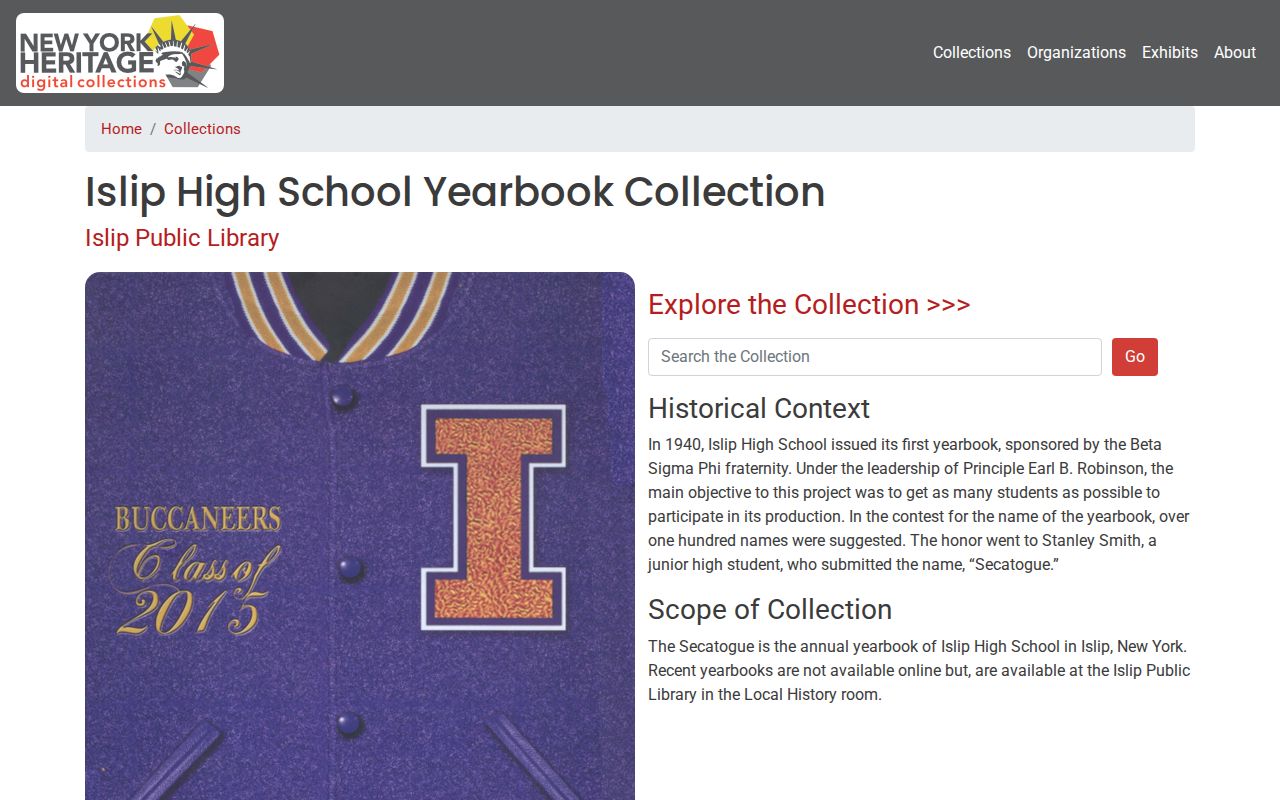
Secatogue adds names and school context to a city-directory trail without substituting for an address or household record.
Reading Town of Islip Directory Entries
No fully opened scanned Islip directory page was available in the research, so no local abbreviation or entry format should be invented. When a local volume is opened, make an inventory of what it actually prints. The expected fields below are a capture checklist, not a transcription from a confirmed Islip page. A directory is time-specific, and a business address, boarder entry, telephone subscriber, widow notation, or household head can each mean something different.
| Name | Surname and given name exactly as printed, including initials, suffixes, and spelling variants. |
|---|---|
| Relationship notation | A spouse or widow notation only if the opened volume prints one; record the abbreviation exactly. |
| Work or business | Occupation, employer, or business address when present, without assuming it is a residence. |
| Address and telephone | House number, street, and telephone number when the volume supplies them. |
| Edition details | Directory year, publisher or title, page, and the section in which the name appears. |
- Criss-cross directory
- A directory arranged by street and address instead of only by name. Confirm that a particular Islip volume has one before using it.
- Householder index
- A name-oriented list that may emphasize the person or household named in the volume, not every occupant at an address.
- Abbreviation key
- The printed guide to that volume’s shorthand. Preserve it exactly instead of expanding a mark from memory.
Town of Islip Directory Snapshots
Myth: an old listing proves someone lived at an address. It does not. The research supports a narrower conclusion: an entry is a snapshot for the printed year and may reflect a business address, a boarder, a telephone subscriber, or a named head of household. A person can be absent because of a move, death, omission, spelling change, or the collection’s coverage limits. It also cannot prove a person’s current residence.
Start with the printed entry, then compare it with a released federal census, local newspapers, and property or probate material where appropriate. Census schedules from 1790 through 1950 are available under the 72-year rule, but their town, hamlet, village, or enumeration-district labels may not match a present address. The December 1890 Islip Sanborn set has five sheets that can supply building, street, use, and lot context. It is not a resident list.
- Save the oldest confirmed name, address, directory title, year, and page.
- Search nearby years and note changes in spelling, spouse notation, occupation, and street number.
- Check a reverse or criss-cross section only after confirming that the specific volume includes one.
- Pair the year with the nearest released census schedule and inspect its geography.
- Use an obituary, probate file, deed, or mortgage date to test whether a disappearance reflects a move, death, or ownership change.
Note: A historical directory entry becomes stronger when two dated sources agree on the name, place, and time.
Town of Islip Directory Newspapers
The New York State Library holdings identify Islip Bulletin material beginning in 1962. Islip Public Library has film for 1962–1988 and 1992–1993, with paper holdings from 1989 forward. The same source lists Islip Press and Islip Herald holdings with gaps. Check the title and reel before ordering or citing an issue, since no single newspaper sequence is complete.
For Sayville and West Sayville, the Sayville Library Long Island Collection holds more than 2,300 cataloged items and offers archives on request, digital newspapers, postcards, and oral histories. A news item can tie a directory name to a hamlet, business, vessel, family, or community event. It still needs date and identity checks when a surname is common.
Town of Islip Directory Archives
The Suffolk County Historical Society research library and archive in Riverhead covers all ten Suffolk County towns and about 300 years of history. It is at 300 West Main Street, Riverhead, NY 11901, and can be reached at 631-727-2881. Research is by appointment Wednesday through Saturday, 12:30 p.m. to 4:30 p.m., with a Saturday appointment required. Ask about research and reproduction terms before requesting copies.
Named holdings include Ackerly notebooks indexing residents from the 17th through 19th centuries, DAR applications, genealogies, biographies, town records, ledgers, diaries, photographs, maps, atlases, cemetery transcriptions, newspapers, and census material. The archive is the right fallback when the Local History Room cannot confirm an exact volume. Its materials can also connect an Islip directory name to the older county record environment without pretending that all items are searchable online.
Review the Suffolk County Historical Society research archive before requesting an appointment.

The Riverhead archive broadens a directory trail with maps, newspapers, family files, and county historical sources that may not appear in a web search.
Tracing Town of Islip Family Directories
A household trail begins with the oldest record that can be checked, not the most convenient result. Follow the surname through adjacent directory years, preserve every address variation, and compare it with the released census years 1900, 1910, 1920, 1930, 1940, and 1950. Suffolk County’s land-record history can help distinguish an owner from a resident: the County Clerk has online land material from 1987, while older transactions require historical research channels. That separation keeps a historical directory clue from becoming an unsupported ownership claim.
A short research timeline helps organize the sources: December 1890 produced the five-sheet Islip Sanborn set; 1940 begins the confirmed Secatogue yearbook sequence; 1950 is the latest released federal census schedule; and 1962 begins the documented Islip Bulletin holdings. FamilySearch’s national directory collection reaches about 1749–1990, but it does not establish an uninterrupted Islip run. Build the chronology from actual volumes and dated records, not an assumed publishing history.